The Hidden Cost of Inefficient Lighting
Have you ever noticed those lights in car parks, stairwells, and corridors in commercial buildings? The ones that always seem to be operating despite there not being a single soul in sight?
These lights run 24/7 “just in case” someone needs light. (With a couple of other reasons, of course, like security.) It’s a common sight in commercial spaces. But what’s the problem?
Those constant hours of operation drain energy and can exponentially inflate electricity bills, especially when traditional lights like fluorescent and halogen bulbs are used. This is where LED sensor bulkhead lights shine bright. Both literally and figuratively.
They’re designed to illuminate only when needed, thanks to their built-in sensors that detect movement and send the signal to turn on the lights automatically. The lights also automatically turn off after a set time, making these the perfect lights for reducing overheads and improving sustainability.
For property managers, landlords, and business owners, switching to LED sensor bulkheads isn’t just a good idea; it’s a financial game-changer.
What Are Sensor Bulkhead Lights?
Sensor bulkhead lights are modern LED fittings that combine durable, weather-resistant housing with intelligent motion detection technology.
They’re built to automatically turn on, dim, or switch off based on occupancy (AKA, when movement is detected), ensuring light is provided ONLY when and where it’s needed.
These lights are especially popular in:
- Car parks and loading bays
- Stairwells and corridors
- Outdoor walkways and entrances
- Apartment blocks and shared spaces
Instead of relying on manual switches or timers, sensor bulkheads react instantly when someone approaches. This not only boosts convenience and safety but also significantly reduces energy waste.
How They Work:
Depends on the build, a sensor bulkhead uses either microwave or PIR (Passive Infrared) sensors to detect motion. When movement is detected, the light turns on at full brightness. Then, after a set period of inactivity, it automatically switches off or dims to a lower level, depending on configuration.
This hands-free operation ensures you’re never lighting an empty space, which helps your building operate more efficiently around the clock.
Types of Sensors Used in Bulkhead Lights
There are two types of sensors used in sensor bulkhead lights, namely microwave and PIR sensors.
Let’s break each one down:
Microwave Sensors emit electromagnetic waves. These waves bounce off surrounding surfaces. When movement disturbs these waves, the light is triggered.
Advantages:
- Has a wider range than PIR sensors.
- Detects motion through glass, thin walls, and doors.
- Ideal for large or irregular spaces. Think car parks or corridors.
- More sensitive and reliable in challenging environments.
Passive Infrared (PIR) Sensors detect body heat within their range. When someone enters this field of detection, the change in infrared energy activates the light.
Advantages:
- Perfect for smaller indoor spaces
- Less prone to false triggers (since they’re not as sensitive as microwave sensors)
- Energy-efficient and cost-effective
Why are Microwave Sensors popular for commercial buildings?
Detection range and reliability are crucial in commercial settings. That’s why microwave sensors offer superior performance compared to PIR sensors.
They’re less affected by temperature or obstructions, making them ideal for areas like underground car parks, warehouse corridors, and external walkways where consistent lighting control is crucial.
How Sensor Bulkheads Save Energy and Money
1.Lights Only When Needed
If it wasn’t clear before, let us say that again. Unlike non-sensor lights that stay on regardless of occupancy, sensor bulkheads activate only when someone is present in the space.
Once the area is empty (no movement is detected), they automatically switch off or dim. This simple feature can reduce energy waste by up to 60–70% in low-traffic areas, such as stairwells, storage rooms, or communal corridors.
2.Lower Running Costs
LEDs, in general, already use up to 80% less energy than fluorescent lamps, resulting in massive energy savings over time. But pair that with motion sensors, and those savings multiply.
Here’s the reality: your lights don’t need to run at full brightness 24 hours every day. They may only need to operate at full brightness for a fraction of the time.
With motion sensors, you can ensure that your lights are at full brightness when needed, and dim or off when not. What does that translate to? Substantially lower energy bills and a faster return on investment, that’s what!
Think about how much multi-floor properties or large car parks would save with motion sensor lights.
3.Extended Lifespan
LED bulkhead lights already have excellent lifespans. But because sensor bulkheads only operate when required, their LEDs experience fewer total operating hours.
Less runtime means less wear and tear, thereby extending the lifespan of both the light and its components. The result? Lower replacement costs, reduced maintenance schedules, and fewer call-outs for facility managers.
4.Smarter Energy Management
Many sensor bulkheads can be integrated with emergency lighting or dimmable functions for even greater efficiency. For example, a bulkhead can dim to 20% brightness when an area is unoccupied, maintaining visibility without wasting power.
Emergency lighting is also a highly sought-after feature, providing an additional layer of safety and protection for your space.
Common Applications of Sensor Bulkheads
Sensor bulkhead lights are among the most versatile fittings available on the market. What sets them apart from other lights is their rugged, compact design, which makes them suitable for both indoor and outdoor environments.
They’re best installed in:
- Apartment block corridors and stairwells – Keep communal areas bright and safe without round-the-clock lighting costs.
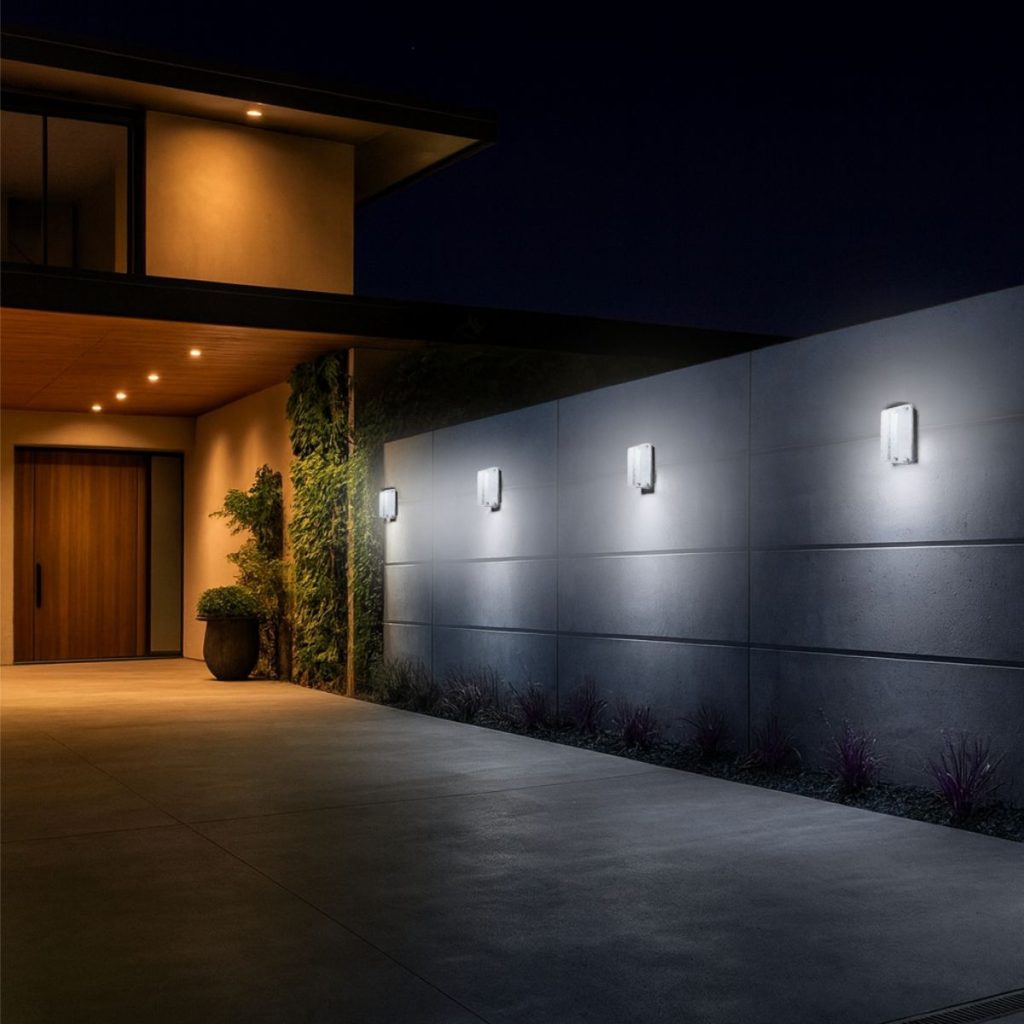
- Outdoor car parks and loading bays – Provide instant light for vehicles and pedestrians when motion is detected.
- Public restrooms and utility areas – Improve hygiene and convenience with automatic illumination.
- Office or warehouse corridors – Light only when staff are moving through.
- Bin stores and back entrances – Keep low-traffic zones safe and secure.
Why They’re Ideal for Shared Spaces
In communal settings where everyone has different schedules, lights often stay on continuously for safety. With sensor bulkhead lights, you can create a balance between efficiency and security.
You can ensure occupants always have light when needed, while drastically reducing energy waste when no one’s around. It’s a win-win for everyone involved.
Additional Benefits Beyond Energy Savings
Better Safety and Security
Sensor bulkheads activate instantly when motion is detected, ensuring that no dark corners or unsafe areas are unaccounted for. This feature also acts as a deterrent against vandalism, trespassing, or loitering, especially in outdoor car parks, alleyways, and storage areas.
Lower Carbon Footprint
One of the main selling points of a sensor bulkhead light is its reduced energy consumption. This signifies fewer carbon emissions. By upgrading to sensor-controlled LEDs, you can further reduce your environmental impact and contribute toward bigger sustainability goals.
Easy Installation and Modern Design
Modern LED bulkheads feature plug-and-play retrofit compatibility. This allows for the direct replacement of older fluorescent fittings without the need to replace the entire fixture. For a commercial space, this means minimal disruption in operations.
Choosing the Right Sensor Bulkhead
Not all bulkhead lights are made the same. To get the best performance and savings, it’s essential to match your light to its environment.
Here’s what to look for:
- Sensor Type: Choose microwave sensors for large or complex spaces, and PIR sensors for smaller indoor rooms.
- IP Rating: Ensure the light has appropriate protection. Get IP65 for outdoor and IP54 for indoor installations.
- Emergency Function: For compliance with UK safety standards, consider emergency bulkhead lights. They can give up to three hours of illumination during power cuts.
Colour Temperature:
- Cool white (5000K-6500K) for outdoor and security areas
- Natural white (4000K) for communal or residential corridors
How to Maximise Energy Savings
Getting the most from your sensor bulkhead setup involves fine-tuning and maintenance:
1.Adjust Sensor Sensitivity and Time Delay: Avoid unnecessary activations by calibrating motion detection to match the space’s size and use.
2.Set Time Delays Wisely: A short delay between activation and switch-off prevents lights from staying on longer than necessary.
3.Combine with Emergency or Dimmable Features: Maintain safety without compromising efficiency. Also keeps your lights reliable when you need them most.
4.Regular Maintenance Checks: Ensure sensors and LEDs remain responsive and dust-free for reliable performance.
5.Use Daylight Sensors: In semi-outdoor or window-lit areas, pair motion detection with daylight sensors to ensure lights only activate when natural light is low. This helps maximise natural light, which is still the best kind of light to have around.
Bright Savings Ahead
In today’s energy-conscious world, sensor LED bulkheads represent one of the smartest upgrades for commercial buildings. They cut waste, reduce bills, and deliver long-lasting, reliable performance, all while enhancing safety and user comfort.