If you’re running a small business, then you’re likely wearing multiple hats. You are the owner, the manager, the problem-solver, and sometimes the cleaner too. With so many things to do in your day-to-day, emergency lighting can easily be shoved to the end of the priority list.
And why wouldn’t it be? It’s often seen as something only large offices, shopping centres, or factories need. But tell you what? That idea is one of the most common misconceptions in workplace safety.
Here’s the truth: most small businesses do need emergency lighting. Besides, there are rules to follow even when the premises or team is small.
Even in small businesses, emergency lighting is about ensuring people can leave your building safely when normal lighting fails. In the event of a power cut, a fire, or an electrical fault, staff and customers should be able to find their way out without panic.
This guide explains everything you need to know about emergency lighting for small businesses and how to stay compliant without unnecessary cost or stress.
Do Small Businesses Really Need Emergency Lighting?
First, we have to address the big question.
Many small business owners believe emergency lighting only applies to large buildings. Understandable, but sadly an incorrect belief. In most cases, small businesses still need emergency lighting, even if they have only a few staff members or a small floor area.
Legal responsibility does not change with business size. What’s important is how people can escape the premises in an emergency, especially at night, if the power goes out.
Here are some factors to consider:
- Occupancy: How many people use the space, including staff and customers.
- Layout: Corridors, internal rooms, stairs, and changes in level.
- Escape routes: Are exits obvious, or do they require guidance?
- Lighting conditions: Whether the space would become dark without power.
Many small premises tick at least one of these boxes.
Emergency lighting is often required in:
- Small offices with internal corridors or meeting rooms.
- Cafés, takeaways, and small restaurants with seating for customers.
- Retail shops with stock rooms or rear exits.
- Workshops, studios, and salons with enclosed spaces or equipment.
- Storage areas without windows.
Even a single escape corridor or a stair to a rear exit can trigger the need for emergency lighting. Emergency lighting is usually needed in areas where people could hesitate, trip, or take a wrong turn in the dark.
What UK Regulations Mean for Small Business Owners
UK regulations can sound intimidating, but the whole idea is straightforward: people must be able to escape safely if something goes wrong.
The Fire Safety Order Explained Simply
Regulatory Reform (Fire Safety) Order 2005, often called the Fire Safety Order.
Under this law, every workplace must have what’s called a Responsible Person. In a small business, this is usually:
- The business owner/employer
- A designated employee
- The person in control of the premises
What are the Responsible Person’s duties?
- Identify fire risks.
- Put safety measures in place.
- Make sure escape routes are safe and usable at all times.
Emergency lighting plays a direct role in this. Escape routes become useless if people cannot see them in the dark, especially when the power fails. That is why emergency lighting is often required for legal compliance.
Think of it this way: If your building relies on artificial lights for people to move around safely, you should assume emergency lighting is needed.
How BS 5266 Applies to Small Premises
BS 5266 still guides the British emergency lighting standard. BS 5266 does not focus on the size of your business. Instead, it looks at:
- Whether escape routes are clearly visible.
- Whether people can move safely during a power failure.
- Whether lighting is suitable for the space and its use.
What does this mean for small premises?
- Escape routes should be provided with emergency lights.
- Stairs, level changes, and exit doors should be well-lit.
- Lights need to be tested and maintained.
Emergency lights are not “install and forget” fixtures. They need to be regularly checked to ensure they work in real emergencies.
And as we said earlier, the floor size does not matter. What’s more important is the risk assessment. A small shop with a rear exit and no windows may need more emergency lighting than a larger open-plan office with lots of natural light and clear exits.
Types of Emergency Lighting Suitable for Small Businesses
You don’t need all the fancy tech and big lights for your small business. A few well-placed fixtures will cover the basics.
Non-Maintained Emergency Lights
These are a popular choice for businesses.
These lights:
- Stay off during normal operation.
- Switch on automatically when the power is cut off.
They are a cost-effective option and work well in spaces that are already well-lit during normal hours.
You can use these lights in:
- Small offices
- Back-of-house areas for retail
- Workshops
- Studios
- Corridors and stairways
Because they operate only during emergencies, they tend to use less energy in day-to-day use.
Maintained Emergency Lights
Maintained emergency lights are different. They work like your regular lights and remain on during a power cut.
They are especially useful in:
- Low-light environments
- Customer-facing spaces
- Areas where lights are often dimmed
You will often see them in:
- Cafés and restaurants
- Takeaways
- Bars and hospitality spaces
- Small venues open to the public
Why use maintained emergency lights? The answer is: consistency. There’s no sudden change, even when power is cut abruptly, so the fixture continues to guide people during an emergency.
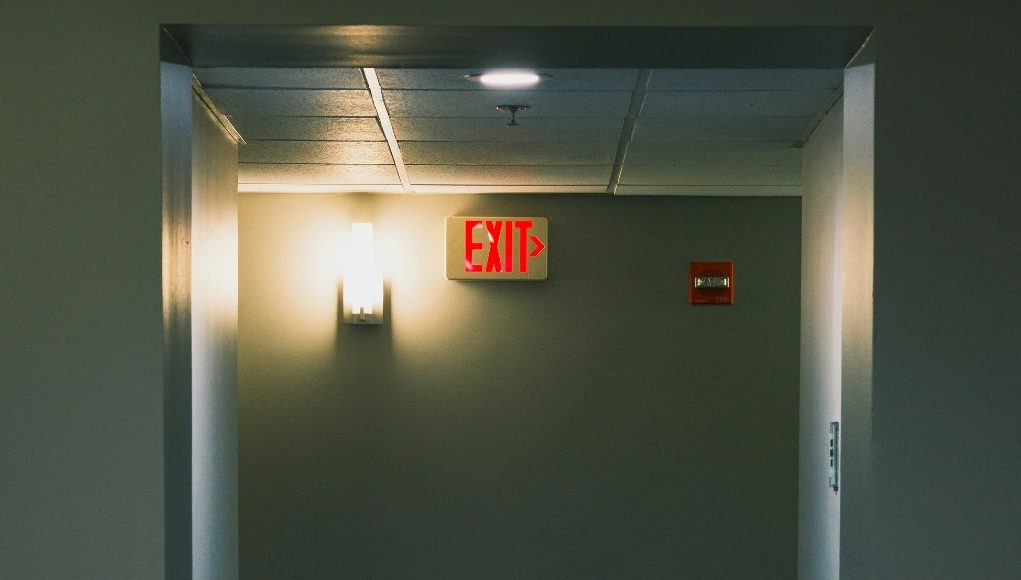
Emergency Exit Signs
Emergency exit signs work hand in hand with emergency lighting.
When exit signage is required:
- The exit is not immediately obvious.
- The escape route changes direction.
- People unfamiliar with the layout frequent the place.
Exit signs must:
- Be clearly visible.
- Be placed above or near exits.
- Be illuminated, either internally or by emergency lighting.
In many small premises, exit signs are essential, especially for rear exits, side doors, or routes through stock rooms. Without them, people may hesitate or head the wrong way when time matters most.
Where Emergency Lighting Is Usually Required in Small Premises
If you’re a small business owner and now you’re worried about budget for emergency lights, here’s the thing… You don’t need to fit emergency lights everywhere. There are only key safety areas to focus on.
- Escape routes and corridors, especially those without windows.
- Near exits, including final exit doors.
- Stairways and changes in level.
- Windowless rooms, such as toilets, storage rooms, or plant areas.
The goal is simple. People should be able to see where to go next and move safely until they reach a place of safety.
So, you don’t need to have emergency lights in every corner, just the right spots.
Emergency Lighting Testing and Maintenance for Small Businesses
Emergency lighting is not a one-off thing. Testing and maintenance are part of the fixture’s (and the building’s) entire lifecycle. The problem is that many people make it more stressful than it needs to be.
You only need to check your emergency lighting every:
- Monthly – A short functional test to confirm the lights switch on when the power is cut. The whole test lasts about 30 seconds to one minute.
- Annually – A full-duration test to ensure batteries last long enough (typically three hours).
Tests should be recorded in a simple logbook. This does not need to be complex. A date, result, actions taken, and signature are usually enough to comply with the emergency lighting testing requirements.
In small businesses, monthly tests can often be carried out by the Responsible Person:
- The business owner
- A trained staff member
Annual tests are sometimes handled by a professional, especially if access is difficult or records are reviewed during inspections.
A well-managed emergency lighting test and logbook helps catch problems before they become real risks.
Common Emergency Lighting Mistakes Small Businesses Make
Not all compliance issues come from neglect. Many of them only come from simple misunderstandings. That’s why it’s crucial to be aware of common mistakes in emergency lighting for small businesses.
1.Assuming size removes obligation. Even a small space can pose a risk if escape routes are unclear in the dark.
2.Installing emergency lights but never testing them. Batteries degrade over time, and a light that looks fine can fail when needed most.
3.Not installing exit signs, especially at rear or staff-only exits.
4.Relying on standard lighting only and forgetting that normal lights often fail first in an emergency.
5.Poor placement. A light installed in the wrong position may technically exist but still fail in a real emergency if it does not properly illuminate the escape route.
Planning, simple checks, and asking for advice when unsure are the smart ways to avoid these issues.
Affordable Ways to Stay Compliant
Compliance does not have to be complicated, and most importantly, expensive… even for small businesses with tight budgets.
Here are some considerations:
1.Despite their higher upfront costs, modern LED emergency lighting offers long life, low energy use, and reduced maintenance. LEDs last longer and provide reliable performance over time.
2.Self-test emergency lights are another smart option. These fixtures have internal timers and automatically check themselves. LED lights indicators tell you if there are issues. They help reduce the need for manual testing, saving you from additional labour costs.
3.Choosing the right number of fixtures is crucial. Over-lighting is impractical and wastes money, while under-lighting poses a risk.
4.Finally, planned upgrades are almost always cheaper than reactive fixes. Replacing outdated fixtures is easier than scrambling to comply after a failed inspection.
Real-World Examples: Emergency Lighting by Business Type
How would emergency lighting fare in real-world scenarios for businesses?
A small office would need emergency lighting in corridors, stairways, and near exits, with exit signs if routes are not obvious.
A café or takeaway would do great with a maintained emergency light in customer areas, plus clear exit signage for rear doors.
A retail shop often needs lighting along the escape route, in stockrooms, and near stairwells.
A workshop or studio may require emergency lighting around equipment, internal rooms, and any enclosed workspaces.
One thing to note: There’s no one-size-fits-all setup. It’s always tailored to the space’s needs. Not excessive, nor lacking.
Getting Started with Emergency Lighting
For anything lighting-related, if you’re not sure where to begin, always start small, then work your way up.
- First, review your fire assessment and see what it says about lighting and escape routes.
- Walk through your premises and imagine a power cut during busy hours. Would people know where to go?
- Identify any gaps, such as dark corridors, unclear exits, or unlit stairs.
Getting the assistance of a lighting specialist can help you avoid overspending by steering you away from fixtures you don’t need.
The next steps are often simple:
- Confirm where emergency lighting is required.
- Choose appropriate fixtures.
- Put a basic testing routine or system in place.
- Adhere to this routine.
At its simplest form, emergency lighting is about ensuring everyone gets out safely if the unexpected happens.